Fiverr is one of the largest freelance platforms in the world. But as a buyer, the experience felt stuck in the past.
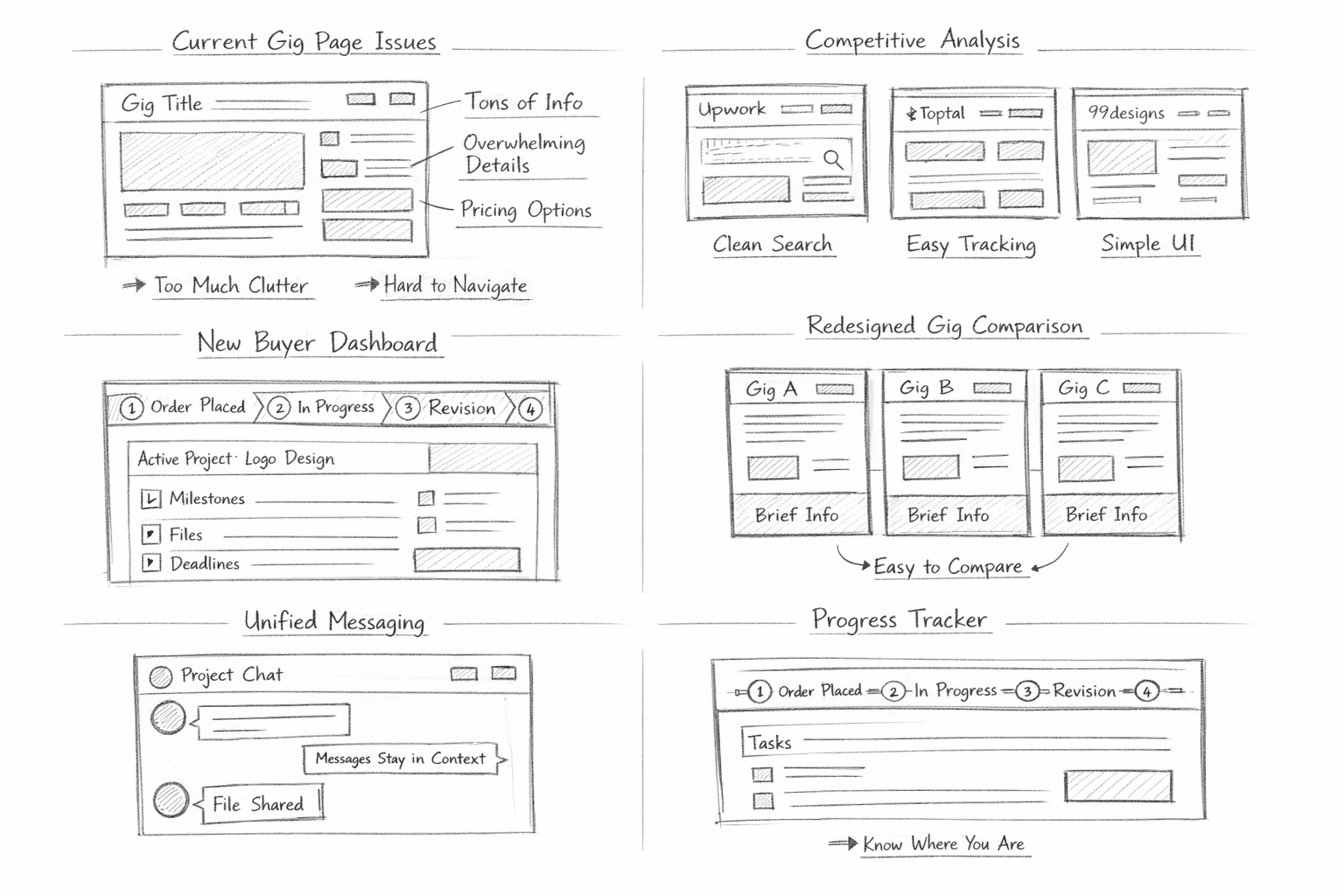
The interface tried to serve both buyers and sellers at the same time, and neither side got what they needed. Gig pages were overloaded with information, project management after purchase was confusing, and it was hard to tell where you were in the process.
As someone who's hired on the platform, I kept running into the same frustrations. So I decided to properly document what was broken and sketch out something better.
The biggest issue was information architecture at every step.
I ran a full heuristic evaluation using Nielsen's 10 usability principles, focusing specifically on the buyer journey from search to active project management. Comparing against Upwork, Toptal, and 99designs surfaced patterns that worked better elsewhere.
- Gig pages — buyers were drowning in details before placing an order
- Post-purchase experience — no clear sense of "where am I in this process?"
- Project tracking — switching between conversations lost all project context
- Comparison — no easy way to compare similar freelancers side-by-side
From systematic audit to wireframed redesign.
Walk the full buyer path
End-to-end walkthrough of the complete buyer journey, documenting every friction point from search to project completion.
Heuristic scoring
Scored each screen against Nielsen's heuristics to find systematic issues — not just surface-level annoyances, but structural UX failures.
Competitive analysis
Compared how Upwork, Toptal, and 99designs handle search, comparison, and project tracking to find patterns that actually work.
Wireframe the solution
Sketched a dedicated buyer dashboard with clear project stages, simplified gig cards, and a chat experience that keeps context visible.
Clarity at every step — from browsing to project delivery.
My redesign introduced three key changes: a buyer dashboard with visual progress stages so you always know where your project stands, simplified gig cards that surface the most important information without overwhelming, and a chat experience that doesn't lose context when you switch between conversations.
The principle throughout was progressive disclosure: show what matters first, let people dig deeper only when they want to.
Good UX doesn't hide information — it surfaces the right information at the right time.