Quest for the Mystic Dice
A Product Owner home assignment: competitive research, feature ideation, and a full product spec for a new in-game feature designed to increase ARPDAU by 5% in a casual mobile game.
The assignment
A mobile gaming studio gave me an open-ended brief: find new opportunities to increase ARPDAU (Average Revenue Per Daily Active User) in their casual dice-rolling game. No constraints, just results.
Rather than jump straight to ideas, I built a structured approach: play the game deeply to understand the core loop, audit the existing monetization features, research what's working in other genres, then ideate and spec the most promising feature end-to-end.
Step 1: Auditing what was already there
Before looking outward, I mapped every revenue-driving feature in the game to understand what was working, what wasn't, and where the gaps were.
- The Store — Daily-refreshed item purchases. Fresh selection creates return visits, but the urgency is mild.
- Dream Pass — Daily missions unlocking a reward ladder, with a paid premium tier. The time-limited structure drives urgency and subscription conversion.
- Event / Daily Offers — Discounted bundles tied to events or a 24-hour window. Solid, but not differentiated from standard mobile patterns.
- Progressive Reward Ladder — Milestones with escalating rewards; higher tiers require payment. The growing value creates a natural "I'm so close" moment.
- Piggy Bank — Players passively accumulate rolls based on kingdom level; once full, they're notified and can purchase the contents. This was the most interesting one: it creates a strong sense of ownership and urgency that visibly moved spending.
The Piggy Bank was my key insight going in: players spend more when they feel they've already earned something and risk losing it. I wanted to build on that psychology.
Step 2: Looking outside the genre
Most casual games already use the same monetization playbook, so I went outside the category to find patterns with real originality.
- Clash of Clans — Resource Raiding & Protection: Players steal gold and elixir from each other, creating constant urgency to spend or protect. The threat of loss drives shields and guard purchases. The key mechanic is loss aversion at scale.
- Brawl Stars — Randomized Loot Boxes: Players unlock boxes through gameplay, but can spend gems to access them faster or buy premium boxes with higher reward odds. The excitement of randomness pairs with a clear spend-to-skip-the-wait path.
- Summoners War — Fusion System: Players collect lower-tier monsters and special resources to fuse them into rare, powerful ones. The multi-step collection process creates sustained engagement and multiple purchase touchpoints along the way.
Step 3: Three feature ideas
Drawing from the audit and research, I proposed three features, each tapping a different monetization mechanic:
- Quest for the Mystic Dice — Collect shards, forge a 10-sided dice, roll it for rare rewards. Shards can be stolen by other players until forged, creating urgency to spend and complete.
- The Wizard Card — A special card drawn from attacks or missions. It reveals a scroll with visible prizes (coins, dice, items). Players can unlock it with keys now, or wait for the next draw — which reshuffles the rewards.
- Nitro Boost — A 30-minute power-up that multiplies all rewards earned (from attacks, steals, mystery boxes, etc.), sold in the store or as a special offer. Short window drives session intensity and spend-to-maximize behaviour.
I chose the Mystic Dice to spec fully because it combines the competitive tension from Clash of Clans with the collection and fusion loop from Summoners War, while fitting naturally into the game's existing steal-and-raid core mechanic.
The feature: Quest for the Mystic Dice
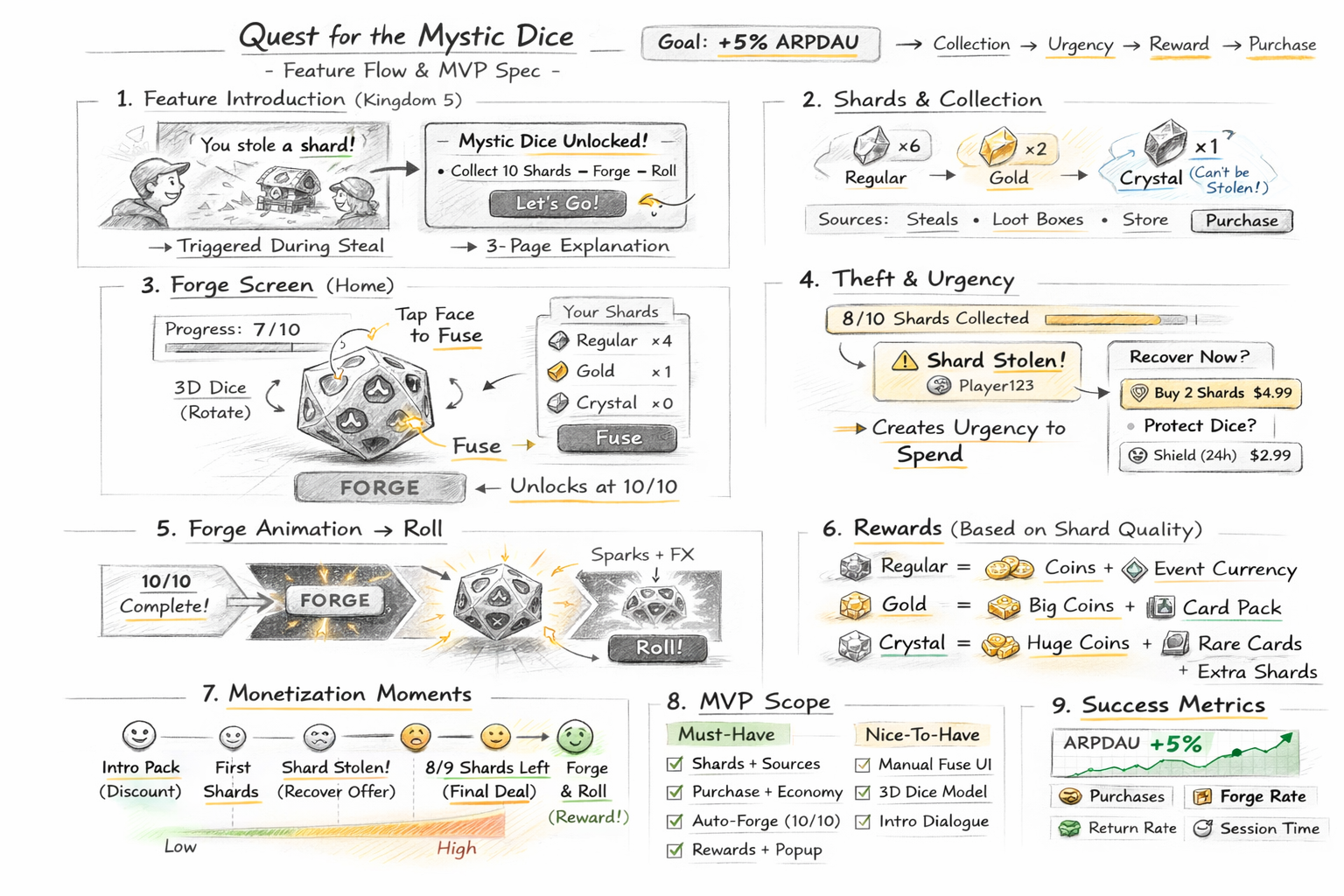
Players collect Mystic Dice Shards through steals, loot boxes, and the store. Collect 10 shards, fuse them into a 10-sided dice, and roll for rare rewards: coins, rolls, cards, event currency.
The catch: shards are vulnerable to theft by other players until all 10 are forged. Crystal Shards — available to buy — are the only type that can't be stolen, offering a direct spend path for players who don't want to risk losing progress.
- Mystic Dice — A 10-faced dice; each face is a slot for one shard.
- Shards — Regular (common prizes), Gold (rare prizes), Crystal (premium prizes; theft-proof).
- Fuse — Manually attach a shard to a chosen face of the dice.
- Forge — Once all 10 faces are filled, lock in the dice and roll for rewards.
Player journey & monetization moments
I mapped the emotional arc of the player through the feature and tied each moment to a monetization opportunity:
- Introduction — Excitement and curiosity. Offer a premium shard starter pack at a special introductory price.
- Getting shards — Sense of progress as steals and loot deliver pieces. No push needed yet.
- A shard gets stolen — Frustration and urgency. Offer a deal with just enough shards to complete the dice, plus an optional theft-protection purchase.
- Almost complete (8–9 shards) — Tension is highest here. Offer the last few shards at a discounted price to close the gap. The sunk cost and proximity to reward make this the strongest conversion moment.
- Forge and roll — Satisfaction and excitement. No push needed; this is the payoff.
Feature introduction
The feature unlocks at Kingdom 5, triggered naturally during a steal. A short dialogue scene plays out between two characters, ending with a popup that explains the mechanic across three pages: how to collect shards, the three shard types and their rewards, and a theft warning. After closing the popup for the first time, the Mystic Dice button appears on the main screen and the player is sent directly to the Forge screen.
Structuring it this way means the mechanic is demonstrated in context, not dumped as a tutorial. The player already has their first shard before they even know the feature exists.
The Forge screen
The Forge screen is the feature's home. It shows the 3D D10 dice model, a progress bar (fused shards / 10), and the FORGE button (disabled until complete). Players can rotate the dice by holding and swiping to inspect it, and tap any face to open the shard selection menu. The question mark button reopens the explanation popup — and I flagged it for analytics monitoring to track how often players come back for help.
Each face has two states: empty (not yet filled) or fused (shard locked in with a visual indicator). The shard selection menu shows available shard counts per type; tapping one fuses it to the selected face instantly.
The Roll screen
Once all 10 faces are fused, the FORGE button activates. Pressing it triggers a forge animation — mystical energy flows into the dice, sparks surround each shard locking in. Then the Roll screen loads with the completed dice spinning slowly.
Tapping Roll launches a rapid spin animation with sparks and electric effects. The dice transforms into light and the existing rewards screen appears, revealing the prizes based on shard quality: Regular shards give coins and small event currency; Gold gives larger coin amounts and card packs; Crystal gives large coin bundles, rare cards, or extra shards for future dice.
MVP scope
I split the feature into must-haves and nice-to-haves to define a shippable MVP that still delivers the core loop.
- Must-have: Shards and collection methods, shard purchase option, auto-forge once 10 shards are collected, working reward system, explanation popup.
- Nice-to-have: Manual face-selection UI, 3D dice model (placeholder acceptable for MVP), introduction dialogue scene.
The biggest MVP cut is the manual fusing system. Instead of letting players choose which shard goes on which face, the dice auto-forges when 10 shards are collected. This removes a layer of interaction that adds richness, but doesn't change the core loop or the monetization logic. It ships faster and can be added post-launch once we confirm engagement.
Resources needed
- R&D — Unity / C# engineers, backend and database support.
- Art — UX/UI designers for screen flows; 3D artists for the dice model and visual effects; animators for fusing, forging, and the roll sequence.
- Sound — Effects for shard fusing, dice rolling, and reward reveal.
- Economy — Reward structure design, drop rate calculation, shard pricing, integration with existing reward systems.
- QA — Feature testing across all states; A/B testing tools (e.g. Firebase or Optimizely) for mechanic and reward variations.
- Analytics & Monetization — Data analysts to track shard collection, forge rates, and spending patterns; monetization experts to balance the purchase funnel.
- Marketing & Support — In-game promotion, community announcements, and player support readiness for launch.
Measuring success
Beyond the 5% ARPDAU target, I defined the signals I'd watch to know if the feature was working and sustainable:
- ARPDAU delta — Measured via A/B test against a control group post-release.
- Purchase behaviour — When do players buy? Which offer (intro pack, "almost done" deal, theft protection) converts best?
- Feature engagement rate — How many active players interact with shards, complete a dice, roll it?
- Return rate — Are players logging back in specifically to collect shards or check theft status?
- Session length — Does Nitro-adjacent urgency (you're close, don't let them steal it) extend sessions?
On the risk side: player fatigue from repetitive collection, reward inflation if drop rates aren't balanced, and monetization burnout if the theft mechanic feels punishing. Solutions I proposed: seasonal shard variants, economy team oversight on drop rates, and affordable protection offers to keep the spend pressure light enough to not frustrate non-payers.