Back to all case studies
Hospitality Tech

Driving In-Stay Revenue Through Behavioral Moments

A product strategy case study for a hospitality tech platform — proposing a shift from static upsell promotions to contextual behavioral triggers that activate hotel guests at the moments they're most ready to decide and buy.

12% → 40% Push Opt-In Target
+30% In-Stay Hub Visits
+8–12% Revenue Per Guest

The problem

70–80% of the platform's upsell revenue was happening pre-arrival. Once guests checked in, engagement dropped sharply. Push opt-in rates were stuck at 12%, and promotions fired at fixed times with no connection to what guests were actually doing.

The result: the platform wasn't present in the guest's decision-making moment. Mid-stay revenue was being left on the table, exposure to offers was low, and the window to drive value after check-in was closing fast.

  • Push opt-in rate stuck at 12%
  • Promotions were time-based, not behavior-based
  • In-stay engagement dropped significantly after arrival
  • Upsell revenue concentrated almost entirely in the pre-arrival window

Goals

Primary goal: Increase in-stay upsell revenue by activating guests at their decision-making moments.

  • Get 40% of guests to opt in to push notifications
  • Boost visits to the In-Stay Hub by 30%
  • Increase in-app sales by 10%
  • Maintain a positive guest experience — no spam perception

The solution: three behavioral triggers

Instead of adding more promotions, the strategy was to activate at the right moment. Three distinct triggers, each tied to a real guest behavior:

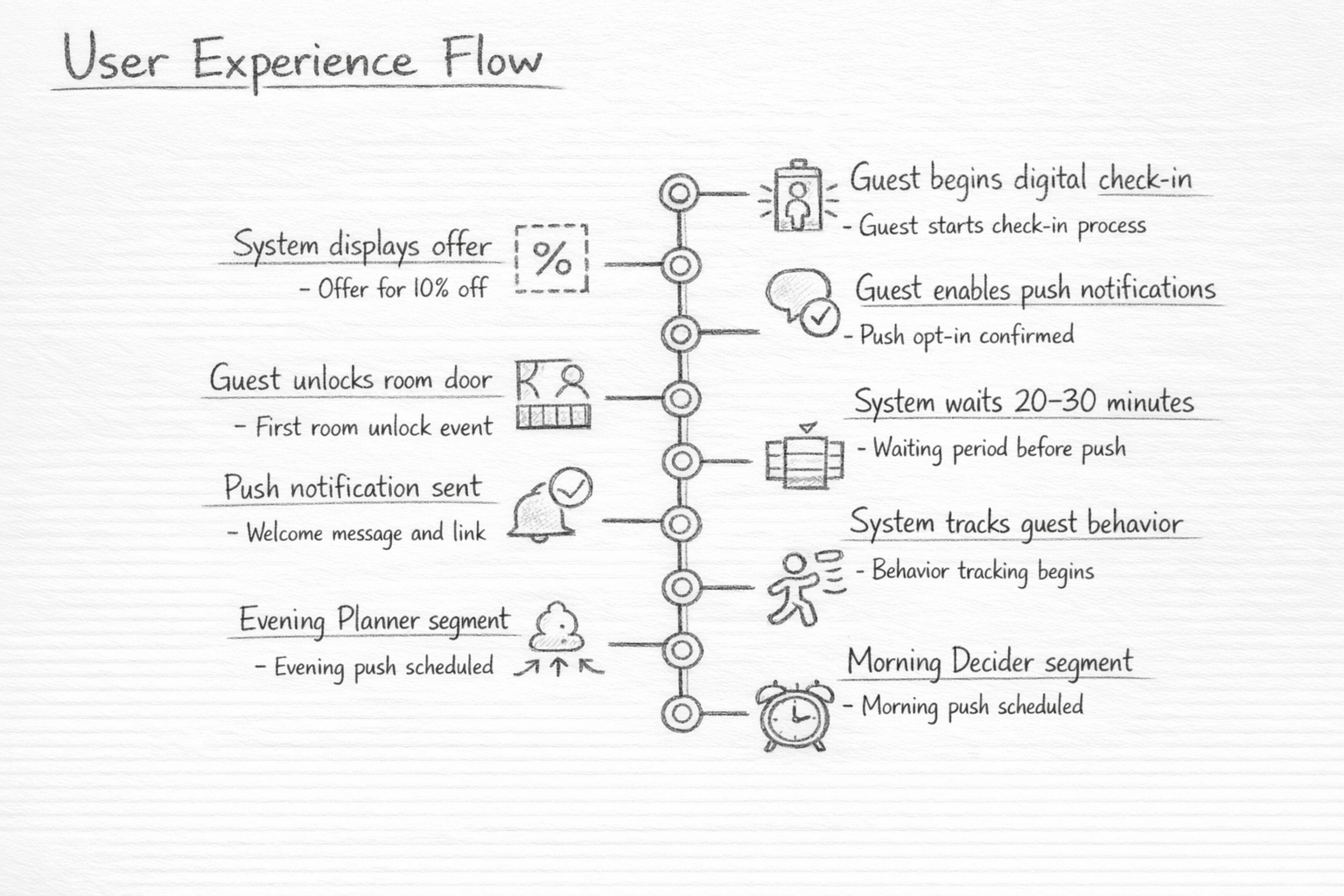
  • Welcome Incentive — During onboarding, guests receive 10% off the hotel's most popular service in exchange for enabling push notifications. A clear value exchange at a high-intent moment.
  • First Room Entry Trigger — 20–30 minutes after the first room unlock, guests receive a contextual push inviting them to explore the In-Stay Hub. The guest has settled in, cognitive load is low, and receptiveness is at its peak.
  • Behavioral Planning Segmentation — Guests are segmented based on observed planning behavior: Evening Planners receive next-day suggestions between 19:00–23:00; Morning Deciders receive same-day suggestions between 07:00–10:00. Right message at the guest's decision-making moment.
In-Stay Revenue — user experience flow

Trigger 1: The Welcome Incentive

During onboarding, guests are offered 10% off the hotel's most popular service in exchange for enabling push notifications. This isn't a generic "allow notifications" prompt — it's a value exchange at the highest-intent moment in the stay: arrival.

  • Why it works: guests are excited, the deal is concrete and immediate, and the action is one tap
  • Projected impact: +20% growth in opt-in rates, expanding the reachable audience for all future campaigns
  • Business impact: more opted-in guests means more revenue exposure for every future push sent

Trigger 2: First Room Entry

20–30 minutes after the first door unlock, guests receive a contextual push inviting them to explore the In-Stay Hub. The timing is deliberate:

  • Guest has settled into the room
  • Cognitive overload from check-in has cleared
  • Emotional excitement from arrival is still present
  • Receptiveness window is at its peak

Technically, this requires linking push delivery to door unlock events — some integration work, but no new tooling. A fallback fires 2 hours after scheduled check-in if no unlock event is detected.

Trigger 3: Behavioral planning segmentation

Based on observed data, hotel guests fall into two distinct planning patterns:

  • Evening Planners (default) — Plan the next day between 19:00–23:00. Typically book spa, tours, and experiences. Mostly couples and leisure stays.
  • Morning Deciders — Decide between 07:00–10:00. Look for "what's happening today." Mostly families, short stays, and mixed travelers.

The existing system sent pushes at fixed times. The new approach segments each guest and delivers messages aligned with their natural planning behavior — higher relevance, higher conversion, less fatigue.

Implementation

Designed to fit within the existing platform infrastructure rather than require new tooling:

  • Uses current messaging system — no new tools needed for push delivery
  • Uses current In-Stay Hub — no new software required
  • One new integration — linking door unlock events to the push trigger logic

Priority classification: High Impact / Medium Effort — recommended for Q2.

What we'll measure

Success is tracked across three layers:

  • Revenue per guest — Target: +8–12% in-stay upsell spending per guest in the first go-round
  • Engagement signals — Push opt-in rate (12% → 40%), notification tap rate post room unlock (target: 18%), In-Stay Hub visit rate (+30%)
  • Guest experience guardrails — Opt-out rate, app uninstalls, app rating. Safety checks to confirm features aren't creating harm.

Learning from escalations

Earlier revenue-scaling efforts surfaced a recurring set of hotel complaints: wrong timing, irrelevant offers, over-frequency ("spam"), cultural conflicts, and overbooking risk. The root cause was revenue being scaled without contextual controls.

This strategy includes built-in guardrails from the start:

  • Frequency caps — limit total pushes per guest per day
  • Capacity-aware promotion — suppress offers when services are near full
  • Quiet hours & blackout windows — property-defined no-send periods
  • Smart segmentation — only send when a behavioral signal is present
  • Property-level control — each hotel can configure their own rules

Principle: Relevance before revenue. Guardrails before scale.

Why this wins

Competitors in the hospitality tech space rely on static, predetermined notification schedules. This system triggers messages dynamically based on real guest behavior and emotional moments.

  • Most platforms struggle with low push adoption — this approach proactively expands the reachable audience through a value-based incentive model
  • Instead of random nudges, activation happens at precisely the right moments — higher relevance, higher conversion, reduced guest fatigue
  • This sets up better personalization infrastructure for future product iterations